6:00 AM wake-up time for the all-day tour into the Sacred Valley! There are 5 major points of interest we’re about to tackle in a day’s work. Herrrrrreeee we go! Haha
Stop 1: Chinchero
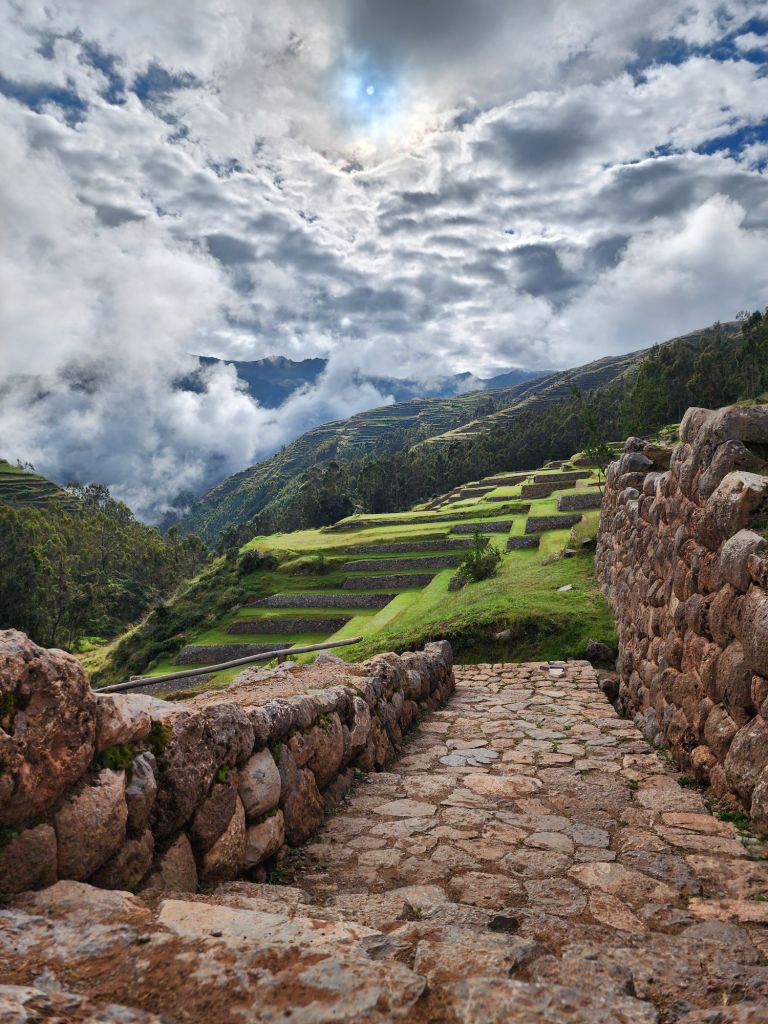
Inhabited since before the Inca, but made famous by the Inca king Túpac Yupanqui, who decided to construct his home in this location. With the Spanish invasion, the most impressive Inca buildings were replaced with colonial churches. Many of the Inca temples were deconstructed, and their materials used to build churches or were built right on top of the foundations of the Inca temples themselves.
We were the first group to enter this beautiful space, and when we thought we had seen the most beautiful view, our guide encouraged us to keep going, and it got even better! If this is just the first stop, I’m positive this will be an incredible tour!
Stop 2: Moray
As we descend from Chinchero, I gaze out my window, watching the clouds hug the mountains, protecting their peaks from the reach of our cameras. There were a few times we were lucky enough to see a glacier peeping through the clouds! I can not imagine how drastic and rugged these mountains must look with no cloud coverage at all….absolutely breathtaking!
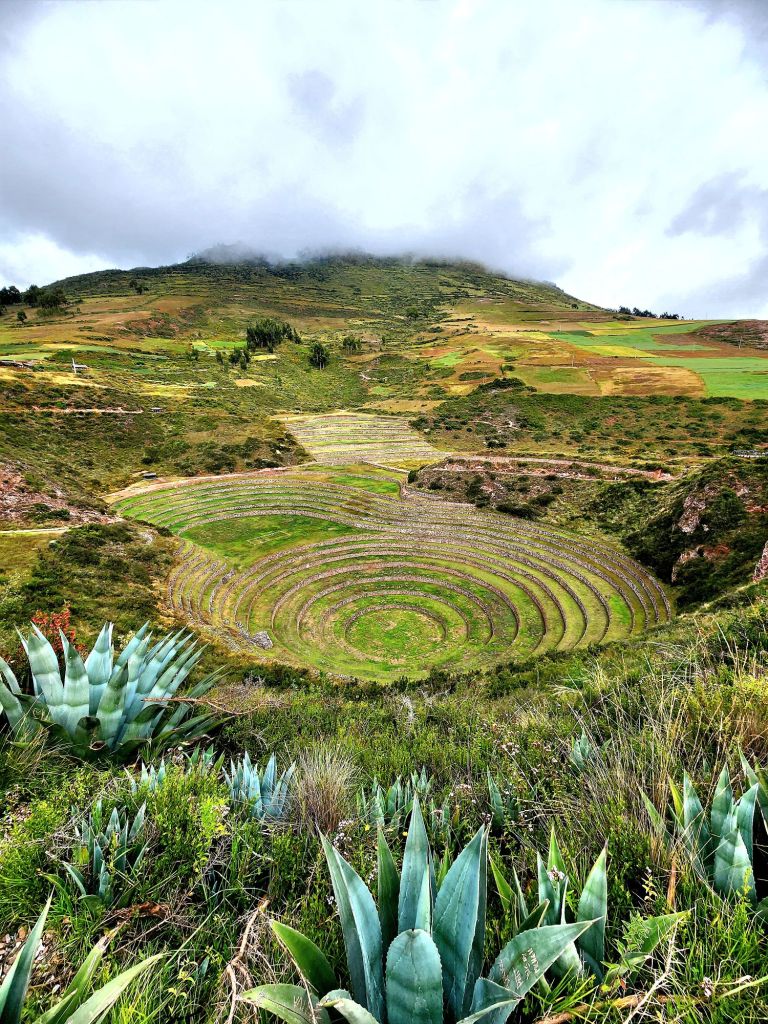
Moray was an agricultural monument that was built into an already existing depression in the landscape. Made of concentric circular terraces, it burrows deep into the mountain, creating a series of microclimates along the way. The very bottom, the deepest terrace, could reach temperatures of 32 degrees Celsius, or 89 Fahrenheit! Amazing! This allowed the Inca to produce mountain, coastal, and tropical crops all in one place!
These terraces also had their very own irrigation system, most likely fed in the dry season by the glacial and snow runoff from the surrounding mountains. There is a smaller circular terraced site just off to the side of the larger Moray. The Inca made a practice model before committing to the larger and more extraordinarily impressive finale.
Stop 3: Maras Salt Mines
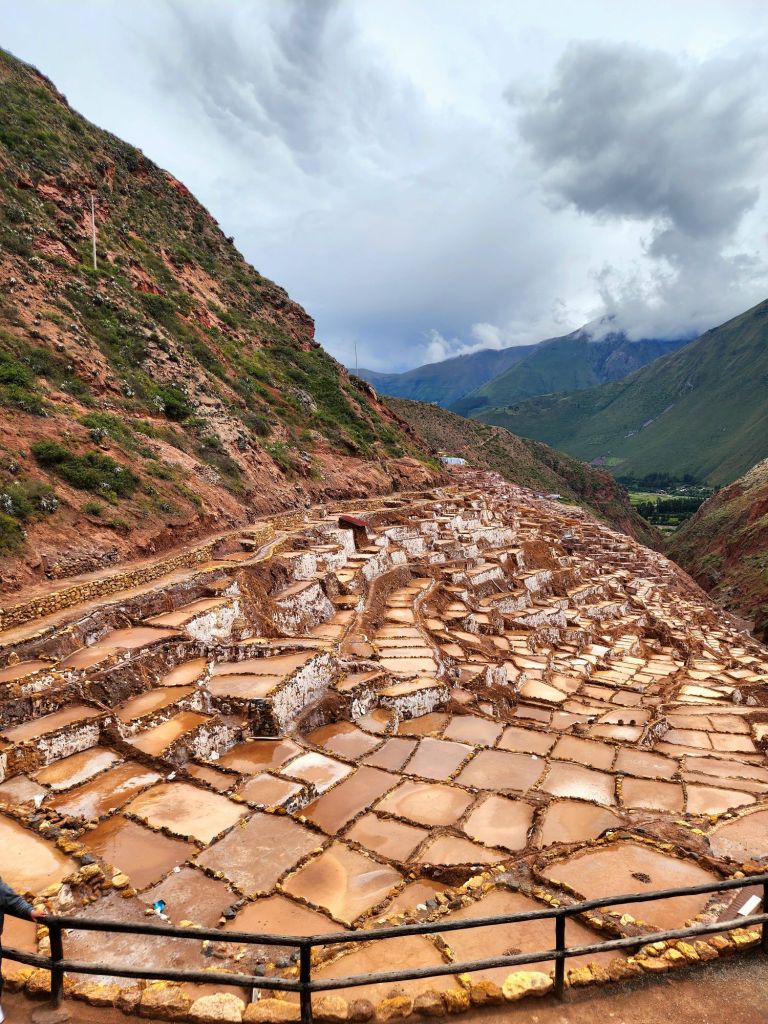
This place was really impressive! We drove along the side of it and got incredible aerial views…it’s massive! The salt pools are only 12 cm deep, and there is a hot spring directly under it, which is necessary for the process of saturating the rock and evaporating the water, leaving behind the salt. The Inca used salt to preserve meat, to make mummies, and it was also used as a bank; salt could be traded for other commodities.
Before we actually arrived to the mine, we stopped by a store and sampled chocolate with the salt extracted from the mine. It was so good! I definitely caved and bought some chocolate and salt. Let me tell you, the smoked salt smells amazing! Maybe it’ll help deodorize my backpack, haha 🤣😅.
Stop 4: Ollyantaytambo

Now this, THIS, was my favorite of the day. We learned that the suffix, “tambo,” means “resting place.” Along the Incan Trail, there are many tambos made for the messengers who would run around 15 km a day, the “chasquis.” The chasquis would run relay-style with messages to different Inca cities. In this way, they were able to cover an unbelievable amount of land in a quick amount of time. According to an online source, “25 runners could cover 240 kilometers in one day.” (HTTPS://historia.National Geographic.com.es/a/chasquis-mensajeros-inca_15459). That’s approximately 150 miles! Wow! I just LOVE this! Just that alone has re-ignited my desire to be a strong runner and to one day conquer the marathon! Hehe 🏃♀️😁.
Back to Ollyantaytambo, this fortress was the last stop before beginning the road to Machu Picchu, and was constructed to protect the infamous site. This impressive site was still being built when the Spanish came, with evidence on some of the large stones with their hoisting points still intact.
At the very top was going to be the Temple of the Sun, created with MASSIVE stones. Many of the Inca sites have these superhuman sized stones, and thinking about how many people it would take to move said stones (500!), let alone chisel them to perfection, is utterly mind-boggling. Absolutely incredible ingenuity!
Across the way from the fortress, there were visible structures on the opposite hill, very high up. Those were used as natural refrigerators! Ha! I love the Inca! They took advantage of the cool glacial breeze to keep their food storage cold…amazing!
Stop 5: Pisac
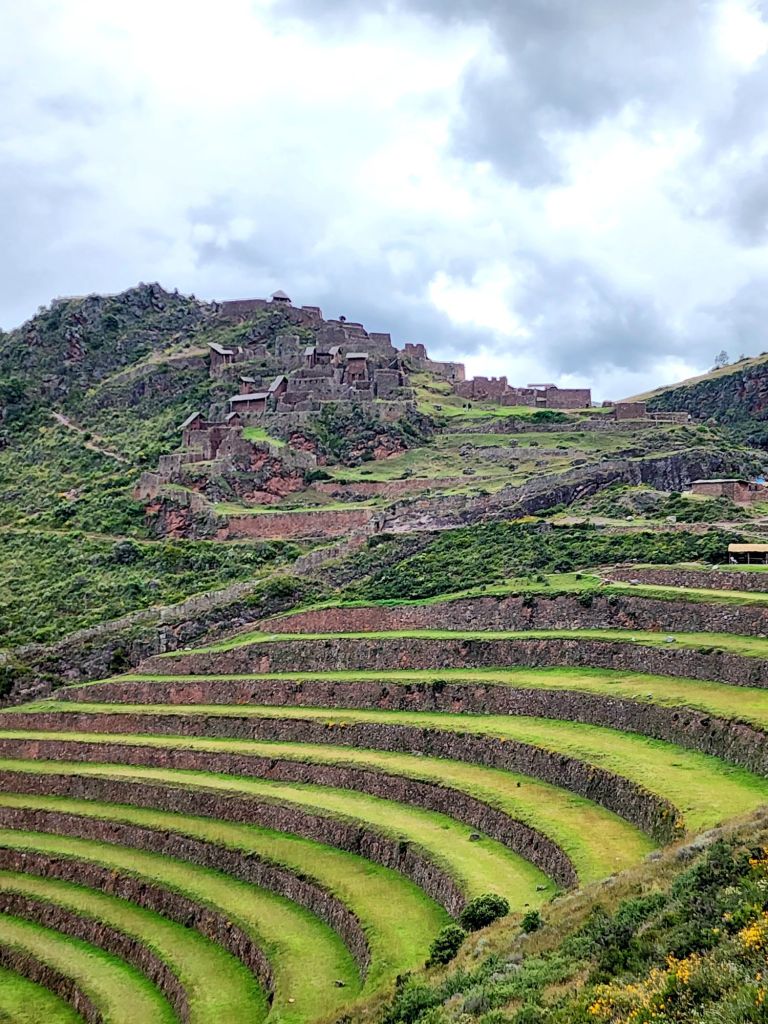
Phew! Finally, at the last stop of the day. This was a city for the average person and can be distinguished from the Inca Imperial buildings by the construction style. The Inca elite used the large boulders, perfectly cut and placed on top of one another without any kind of mortar, for temples and palaces. The average people used smaller stones and mud. The most impressive part of this site was the 150 terraces! Similar to Moray, they were able to create micro climates by changing the height of each terrace, allowing more or less cool air to reach each terrace.
Behind the terraces were moutains that were used as a cemetary. Mummies were placed in the fetal position and into circular holes in the mountain. In this way, the deceased were given back to “Pachamama,” or “Mother Earth,” and the cycle of life continued to rebirth and reincarnation. In Quechua, there isn’t a way to say goodbye, as the cosmology and philosophy suggest that life never ends, and instead a heartfelt “See you again” was said in place of “goodbye.”
This day tour was jam-packed, and it was all worth it! I only wish we could’ve seen more! Haha. Below is the tour I did, and I would highly recommend it. I looked around for other tours, but I couldn’t find one that included all of these places.
From Cusco: Sacred Valley & Maras Salt Mines Tour with Lunch
 Taking Off With Amelia